
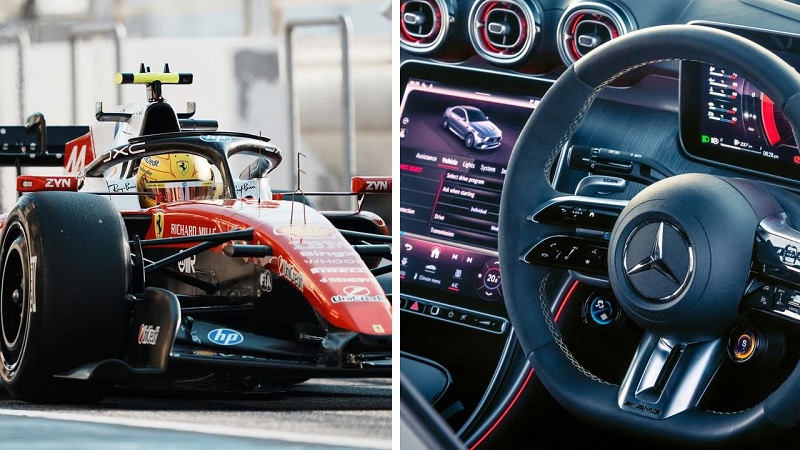

Formula One is universally recognized as the absolute pinnacle of global motorsport. Every weekend during the racing season, millions of fans tune in to watch twenty drivers push the physical limits of automotive engineering around the most demanding circuits on the planet. However, beyond the glamour, the fierce rivalries, and the champagne celebrations lies a secondary, arguably more important reality. Formula One is a high-speed, high-stakes research and development laboratory. The astronomical budgets spent by constructors to shave mere fractions of a second off a lap time eventually yield technological breakthroughs that reshape the global automotive industry.
When you sit behind the wheel of your daily commuter car, you are interacting with decades of racing heritage. From the way your engine manages fuel to the buttons on your steering wheel, the DNA of motorsport is woven deeply into modern consumer vehicles. Understanding this trickle-down effect reveals exactly why automakers are willing to invest billions into racing programs, and how the relentless pursuit of speed ultimately results in safer, more efficient, and more reliable cars for the general public.
The Proving Ground for Hybrid Powertrains
Historically, racing engines were simply massive, fuel-hungry blocks of metal designed solely for raw horsepower. Today, the power units used in Formula One are the most efficient internal combustion engines ever created. The push toward hybrid technology on the track has directly accelerated the development of the hybrid and electric vehicles parked in driveways around the world.
Mastering Regenerative Braking
One of the most significant technological crossovers in recent automotive history is regenerative braking. In 2009, Formula One introduced the Kinetic Energy Recovery System (KERS). This system allowed cars to capture the kinetic energy that is normally lost as heat during heavy braking, store it in a battery, and deploy it later as an electric horsepower boost.
Today, this exact principle is the foundational technology behind almost every hybrid and electric vehicle on the market. When you take your foot off the accelerator in a modern electric vehicle and feel the car naturally slow down, you are experiencing a refined version of KERS. The electric motor acts as a generator, capturing kinetic energy to recharge the battery and extend the vehicle’s driving range. What began as a tool to execute high-speed overtakes on the racetrack is now a vital component in maximizing the fuel economy of suburban commuter cars.
Extreme Thermal Efficiency and Downsizing
Modern Formula One cars utilize highly complex 1.6-liter turbocharged V6 engines paired with electrical components. A key part of this system is the Motor Generator Unit-Heat (MGU-H), which captures exhaust gases that would otherwise be wasted and converts them into electrical energy to eliminate turbo lag. While the MGU-H is incredibly expensive and complex, the underlying philosophy—doing more with less—has revolutionized the street car industry.
Automakers have rapidly shifted away from large-displacement V8 engines in favor of smaller, turbocharged four-cylinder and six-cylinder engines. By utilizing advanced turbocharging techniques perfected on the track, manufacturers can provide consumers with the horsepower they expect while drastically reducing fuel consumption and emissions.
The Evolution of the Transmission
If you drive a modern car with an automatic transmission, there is a very high probability that you are benefiting directly from transmission technology developed for the racetrack. The demand for lightning-fast, error-free gear changes under immense pressure forced engineers to rethink how a gearbox should operate.
The Rise of Paddle Shifters In 1989, Ferrari introduced the first semi-automatic gearbox in Formula One, featuring paddle shifters mounted directly behind the steering wheel. This allowed the driver to change gears in milliseconds without ever taking their hands off the wheel or using a manual clutch pedal. Within a decade, this technology began appearing in high-end Italian sports cars. Today, paddle shifters are ubiquitous. You can find them in family SUVs, economy hatchbacks, and minivans, offering drivers better control over their vehicle’s power delivery during steep descents or aggressive merging maneuvers.
Dual-Clutch Transmissions (DCT) The quest for seamless shifting also led to the widespread adoption of the Dual-Clutch Transmission in street cars. By utilizing two separate clutches—one for odd gears and one for even gears—the vehicle’s computer can pre-select the next gear before the shift even occurs. This results in incredibly smooth, rapid gear changes that maximize fuel efficiency and performance. What was once highly experimental racing technology is now a standard feature in everything from hot hatches to luxury sedans.
Aerodynamics and Fluid Dynamics
In motorsport, manipulating the air that flows over, under, and around the vehicle is just as important as the engine itself. Formula One engineers use advanced wind tunnels and Computational Fluid Dynamics (CFD) software to generate massive amounts of downforce, essentially pushing the car into the asphalt to increase cornering grip. While daily drivers do not need to take corners at 150 miles per hour, the science of aerodynamics plays a crucial role in highway driving.
Instead of generating downforce, consumer automakers use CFD technology pioneered in racing to reduce aerodynamic drag. The less air resistance a car faces, the less fuel the engine has to burn to maintain highway speeds. This is why modern cars feature sleek, teardrop shapes, integrated door handles, and active grille shutters that close off airflow to the radiator when cooling is not needed.
Furthermore, Formula One teams rely heavily on flat underbodies and rear diffusers to manage the turbulent air beneath the car. If you look under a modern electric vehicle or a high-efficiency commuter car, you will likely see a perfectly smooth, paneled undercarriage. This track-derived design choice reduces drag, minimizes wind noise in the cabin, and significantly improves overall fuel economy.
Advanced Materials and Lightweighting
Weight is the enemy of both performance and efficiency. For decades, racing engineers have obsessively searched for materials that offer maximum structural strength with minimal weight. The most famous resulting innovation is the extensive use of carbon fiber.
In 1981, McLaren revolutionized motorsport by introducing a car built entirely around a carbon fiber composite monocoque chassis. It was immensely lighter and exponentially stronger than traditional aluminum frames. While true carbon fiber remains too expensive for mass-produced budget cars, it is now heavily utilized in the sports car market and premium electric vehicles to offset the heavy weight of battery packs.
More importantly, the philosophy of lightweighting has completely altered how everyday cars are built. Automakers now use aerospace-grade adhesives, high-strength boron steel, and advanced aluminum alloys in standard vehicle production. These materials allow for thinner structural pillars and lighter chassis components without sacrificing safety, resulting in daily drivers that are more agile, more fuel-efficient, and structurally safer in the event of a collision.
Onboard Telemetry and Predictive Maintenance
A modern Formula One car is covered in hundreds of advanced sensors that monitor everything from tire core temperatures to exact fluid pressures. These sensors transmit terabytes of data back to the pit wall in real-time, allowing engineers to predict mechanical failures before they happen and optimize the car’s performance on the fly.
This concept of constant digital monitoring is now standard in the consumer automotive industry. The modern equivalent of racing telemetry is the Onboard Diagnostics (OBD) system found in your daily driver. Advanced sensor networks now continuously monitor your engine’s air-to-fuel ratio, transmission fluid temperatures, and individual tire pressures.
When your vehicle’s infotainment system alerts you that a specific tire is low on air, or your dashboard suggests that it is time for an oil change based on your specific driving habits rather than a static mileage counter, you are utilizing predictive maintenance technology born from the necessity of racing telemetry.
Steering Wheels as Command Centers
Look at a photograph of a racing steering wheel from the 1970s, and you will see a simple circular rim wrapped in leather or suede. Look at a modern Formula One steering wheel, and you will see a complex computer interface covered in digital screens, dials, and dozens of buttons that control brake bias, engine mapping, and radio communications.
Because drivers cannot afford to take their eyes off the road or their hands off the wheel, engineers were forced to consolidate all crucial controls into the steering wheel itself. This ergonomic philosophy has seamlessly transitioned to the consumer market. The modern multi-function steering wheel allows everyday drivers to adjust audio volume, answer phone calls, set adaptive cruise control distances, and cycle through digital dashboard menus without ever removing their hands from the 9-and-3 positions. This track-inspired layout has drastically reduced driver distraction and improved overall road safety.
The Future: Sustainable Fuels and the Road Ahead
The relationship between motorsport and the consumer industry is not slowing down. As the world pushes toward aggressive emissions targets, Formula One is preparing to introduce engines powered entirely by 100% sustainable, drop-in synthetic fuels by 2026. These advanced fuels are engineered in a laboratory to capture carbon from the atmosphere during their creation, resulting in a net-zero carbon footprint when burned.
If this technology can be successfully scaled, it has the potential to save the internal combustion engine for the everyday consumer. It could allow millions of existing daily drivers to become carbon neutral without requiring owners to purchase brand-new electric vehicles.
Ultimately, the vehicles we rely on to commute to work, drop our children off at school, and embark on road trips are heavily indebted to the extreme world of motorsport. As long as engineers continue to push the boundaries of physics on the racetrack, the daily driver will continue to evolve, becoming safer, smarter, and more efficient with every passing generation.

Comments are closed.